
Bren on the Road is a great blog for travel bloggers (and people interested in becoming travel bloggers), and he just wrote a thought-provoking piece about why bitcoin is going to win. It just might blow your mind. Enjoy.

This isn’t an article about Bitcoin.
I’ll forgive you for thinking so, because of the title. But it’s not. It’s an article about travel, people, life, and the amazing world around us.
Let me tell you a story.
When I visited Tanzania for the first time, the security guard at my hostel was a Masai. The Masai are a tribe in East Africa that still maintain much of their traditional lifestyle. They live in faraway villages, herding cows, sleeping in huts made of mud and dung. Usually there is no electricity or running water.
The guard and I became friends, and after several weeks, he invited some of us out to his village for a night. We must have walked at least thirty minutes from an open road in the middle of the countryside to get to this village. It was exactly as I imagined.
His mother cooked dinner for us that night in a tiny hut on an open fire. We slept in another tiny hut; three of us shared a bed – a Masai warrior, a white boy from America and a little Chinese guy, all spooning like dominos – because that’s the only space they had. We drank milk straight from the cow. We brushed our teeth using sticks from a special tree, with sap that tasted like cinnamon.
But here’s the strangest thing I remember:
That night, while we were all sitting around the fire, eating corn and drinking beers, one of these Masai guys pulled out his Nokia phone and added us on Facebook. This was in 2011. I was still using a flip phone back then. I didn’t get an internet phone until 2012.
How does a guy living without water, without electricity, in a remote village in Tanzania, get internet on his phone before me – a Chartered Accountant earning thousands of dollars per week in New Zealand?
What I’ve described here is a technological phenomenon that swept through Africa during the early 2000’s. In many African cities, there are no landlines. Most people have never seen a landline phone before, except in the movies. They went straight from sending letters in the post to sending text messages on a Nokia. For many of them, a Nokia cellphone is the first phone they have ever used.
The term for this is “leapfrog technology”. Kids are probably studying it in economics now. It occurs when a community is so far behind, they end up skipping an entire generation of technology and going straight to its successor. It has happened numerous times in recent history, and with it, goes the disappearance of another industry. Go and check how many fax machines have been sold in Africa. They have probably never heard of the fax machine.
That’s the problem with infrastructure; it’s permanent. Once you lay down a railroad, that’s what you’ve got. You can’t change it every year, like a website. That means it’s great, until it isn’t. You put down phone lines, and twenty years later you need to spend millions of dollars digging them all out again. While you’re spending all your time and money on that, the guy who couldn’t afford those lines in the first place is starting to build cellphone towers. It happens all the time. It’s just that most of us do not realise this, because we don’t live long enough to see the full cycle. The only way to see the full cycle, is to have a time machine.
Plot twist: We do have time machines. They’re called airplanes. If you fly to Ethiopia, Uganda, Cambodia, Bangladesh, Nicaragua – it’s a trip back to the 1940’s. People are still killing chickens in their backyard and fetching water from the river. There are people who have never used a microwave, or even an oven, or even a stove top. They’re still cooking every meal over an open fire. I’ve met people who have never heard of McDonald’s. They don’t even know what a fast food chain is. They don’t have bank accounts – in fact, they have never even seen a bank.
Yet they have Facebook. They know how to Google.
Look at this photo:

This picture is from a few years ago. The girl playing with my iPhone is 8 years old. Her house doesn’t even have basic plumbing. No taps. Their toilet is still a hole in the ground. No electricity. No water. Never seen a landline phone in her life.
But all the adults in her family have cellphones. She knows how to reach me on Whatsapp.
This is what leapfrog technology looks like.
It sounds bizarre, but on the road, you see this kind of thing all the time. There have been many leapfrog technologies, and there are going to be many more. Here’s another example of one I see happening already:
In many countries, especially in Africa, the public transport is abysmal. If you go to Nairobi right now, they use recycled vans as public transport. They’re using old, imported, twelve seater vans, on the verge of falling apart, and they cram 14 or 15 people in. They charge them about 50 cents each and they sit in Nairobi traffic, crawling slower than a tricycle. It takes hours to get anywhere. That’s public transport in Nairobi right now. I’ve used this exact system in many countries across the continent – Uganda, Zimbabwe, Tanzania, Ethiopia. But many of these countries will never dig up their roads and lay down a subway system. They’ll go straight to the next thing, maybe Elon Musk’s crazy hyper-speed tunnel or, self driving Uber buses. Nobody knows. But they’re going to leapfrog the subway, just like they did with the landline.
This is what leapfrog technology does. It’s why the Chinas overtake the Japans, and the Indias overtake the Britains. It’s why Shanghai’s metro system makes the New York subway look like a toy train set.
And it’s also the reason Bitcoin is going to win.
Let me build on this with a second story.
I send money to Tanzania every year, usually two or three times, to pay school fees. It’s a couple of thousand dollars maybe. The first time, I tried to send a SWIFT payment directly to the school bank account. You might have heard of SWIFT. It’s an interbank technology from the seventies. My payment got bounced twice. Each time, the bank returned the money, minus $100. That’s the best technology banks have right now. They need a week and $100 to tell me “Sorry, we couldn’t send your money.” I will soon explain how this is going to turn banks into the next fax machine, although the reasons are probably pretty clear to you already.
Then I started using Western Union for a few years. Western Union is fast, but it’s expensive. It’s disgustingly expensive. When you work out the loaded exchange rate, plus the fee, Western Union ends up taking a cut of around 8%-12% each time. This is why Western Union is also going to be the next fax machine. When you shave 12% off the remittances of the poorest people in the world for two decades, people are going to turn you into a fax machine pretty quickly.
Last year there was another small improvement. My people in Tanzania finally have a bank account, so I sent money to their account via Xendpay. Here’s how that works – I send money to Xendpay on my credit card. Xendpay takes a cut. Then they change the money to USD and send it to the Tanzanian bank. The Tanzanian bank takes a cut. Then they change the USD to Tanzanian shillings. They take another cut. Then they deposit it into my friend’s bank account. When she makes the transfer to the school, the bank takes another cut. The whole process takes about five days. The total cut by middlemen is about $60.
Five days. Sixty dollars. Cheaper than a bank. Cheaper than Western Union. Still pretty shitty.
This probably seems normal to you, because that’s how banking is. You’re probably thinking, what is this guy complaining about? If you send money to another country, it’s going to take a few days. Just plan ahead, what’s the problem? You gotta pay a fee? That’s life. What’s the problem? Deal with it.
Here’s what that sounds like to me:
When you do a school project, you just Google the topic and find out whatever you need to know in five seconds, right?
Well here’s what I used to do: I’d wait until the next day before doing anything. Even if the project was due soon and I hadn’t started, I’d wait until the next day. Why? Because the library was closed. I’d go to school early the next day, go to the library and get the books I needed. Then I’d pay 10 cents per page to photocopy it all. It would cost me two or three dollars probably, to photocopy everything I wanted. If you’re in school right now, you probably don’t even know what a photocopier is. It’s a machine that does exactly the same thing as your phone camera, but it’s the size of a dishwasher and can only do black and white. Then I took my pile of photocopies and took them home to work on my project. That’s how we did school research in the nineties.
Why am I telling you this?
Because waiting two days to go to the library and paying $3 to photocopy all the information you need is the exact same problem as waiting five days for a bank transfer to clear. It’s a problem. A big problem. You just don’t know it yet, because when it comes to banking, you’re still using a fax machine. You’re using the fax machine because Whatsapp hasn’t been invented yet. But the banking equivalent of Whatsapp is coming soon. In fact, it’s already here. Bitcoin is the banking equivalent of Whatsapp. That’s why Bitcoin is going to win.
When I talk about Bitcoin, I’m talking in general terms. I’m talking about cryptocurrency. I’m talking about the blockchain. A lot of the things I do are digital – I run all my businesses on the internet – so I have already been involved in this new way of banking. I have paid for things in Bitcoin. I have paid for things in Litecoin. I have paid for things in Bitcoin Cash. I have paid for things in Ether. When I talk about Bitcoin, I’m talking about all of those. And I’ve seen them work. I’ve seen people using a Bitcoin debit card. It works exactly like a normal debit card. It’s connected to your Bitcoin wallet, and you can go swipe it at 7-Eleven and buy a donut with your Bitcoin. For those that are saying it’s not real money, it is real money. You can buy donuts with it right now in 2018. It works.
Here’s where it gets exciting.
When you send Bitcoin to someone, it can be anyone. It can be anyone, anywhere in the world. They do not need to put on their shoes and go down to the bank with two forms of ID, a statement of their water bill and $100 in cash to set up a bank account, then wait two days for all that information to clear, then return to the bank two days later to add a pin to their debit card so they can finally withdraw the money. You think that’s an exaggeration? Ask anyone who’s moved to London lately and tried to set up their bank accounts. It’s not an exaggeration.
But all that doesn’t matter anymore. You can now download an app on your phone, and I can send Bitcoin or any other cryptocurrency to you, anywhere in the world. Depending on the currency, it will take less than a few minutes. It might even be instant. It will cost around ten cents, probably.
“But Bren, why do I need that? I have a bank account already, I can withdraw money instantly from any ATM in the world, I can pay for everything in five seconds with my VISA debit, I can log on to my internet banking and open a new account whenever I want. Why do I need Bitcoin?”
The answer is: You don’t. And if you live in Australia, New Zealand, America, Europe, probably your friends don’t either. But you’re completely missing the point.
Here’s something to think about. Next time you travel through Thailand, go down to the fruit cart on the corner and try buying your breakfast with a VISA debit. I can tell you now, you’re not having breakfast that day.
If four million people in New Zealand don’t need Bitcoin, that’s fine. They can keep using their bank. If 300 million people in America don’t need Bitcoin, that’s fine too. But there are two billion other people in the world who don’t have a bank account. If you’ve time travelled, you would have met them. About a billion more have nothing but a basic checking account which they never use. This is almost half the world. I meet these people all the time. These people have remained unbanked, completely excluded from economic opportunities of the last fifty years, because banks have no interest in banking them. Banks are not interested in opening an account for the peanut guy so he can deposit $1.50 into his savings account each day. There is no money to be made from the 100 people who sell corn to each other living in a village 200km out of the city.
But what those people have is a $100 Chinese smartphone. Just like my Masai friend in Tanzania. They have a data connection. And they have a little solar panel, about the size of a cereal box, to charge their phone every two days. I have gifted several of these to people in Tanzania, they cost about $11 and look like this:

Now, let’s say these people want a bank account. You tell these people they have two choices.
Choice A: They can download an app on their phone and within the hour they can send and receive money to anyone, anywhere in the world.
Or, Choice B: They can walk to the main road, sit on a bus for two hours, go to the citizen’s office and apply for a passport so they have a form of ID, wait three days, then get on the bus again and go pick up the passport, then go and wait in line at the bank for an hour (because in an African bank you will be waiting for at least an hour), ask to open up an account, and then every week take the same two hour bus ride into town to deposit money into their savings, while also paying $5 per month for the rest of their life to keep that account open.
Which one do you think they’re going to choose?
This is why banks are going to get leapfrogged. This is why Bitcoin is going to win.
Here’s another reason why Bitcoin is going to win: We already know it works. In Africa, they already have a Bitcoin clone. It’s called M-Pesa. If you’ve never heard of M-Pesa, it’s a digital money that originated in Kenya in 2007. It went like this:
The Kenyan cellphone provider, Safaricom, had a function on their sim cards, where you could send credit or ‘minutes’ to people. The interesting thing was, since everybody had a cellphone the value of a “minute” was universal, just like money. So, people started using it like money. Maybe you get a taxi, you forget your wallet, and you say to the driver “How about I just send you some minutes instead?” This became so common that Safaricom built an official system for it, now known as M-Pesa (pesa is the Swahili word for money). Today with M-Pesa, anyone with a sim card, even on the crappiest $10 cellphone, has an instant bank account. They can pay and receive money from anyone instantly via a simple text message. This was only launched ten years ago. Today, M-Pesa accounts for 48% of Kenya’s GDP. Everybody uses it. This is why many people in Kenya don’t even have a bank account. They don’t need one. They leapfrogged banking.
But there’s a catch. Kenyan M-Pesa only works in Kenya. I can’t send money from New Zealand to an M-Pesa account. I’ve tried. There’s also a transaction limit, of around $500. But here’s the second catch: Bitcoin is just like M-Pesa. Only Bitcoin transactions are limitless. And they’re global.
Bitcoin is like M-Pesa for the whole world.
Right now, this means nothing to most people. Most of you have zero need or desire to send money instantly to Kenya. That’s fine.
But I want you to think bigger. I want you to think about how much your life can change when you can be paid by anyone in the world, instantly. If you can receive money from anywhere in the world, instantly. I earn money in about five different currencies. I’m waiting for money to clear all the time. This will be amazing for me. But even if it doesn’t excite you, you don’t need to care right now. Just like you don’t need to use Google to research something. You can still go down to the library and photocopy a textbook if you want. But that is not where the world is going.
Let me show you something. I travel everywhere with a travel wallet. In that wallet I have my passports, my visas, bank statements, credit cards, and I also have cash. Here’s what that cash stash looks like right now:

Do you know what this is? This is the equivalent of a photocopied textbook. This is the equivalent of sending my emails by fax machine. I can guarantee you kids in ten years will look at this photo and have no idea what they are looking at. I’m not collecting these currencies. This is just leftovers I’ve unintentionally accumulated over my travels. Why have I accumulated them? Because I can’t spend them. That’s because each of these pieces of paper can only be used in one very specific corner of the world. If you think about it, that’s ridiculous. Currency is one of the last areas of our lives to be globalized by the internet, and it’s the one that most needs to be. This is why Bitcoin is going to win.
Let me give you a more real-life example. If you go to the border of Kenya and Tanzania, you’re going to see a lot of cash changing hands. It will be people such as little souvenir sellers on the streets selling bracelets to tourists from around the world. What you’ll notice is they are not using one currency. They aren’t even using two currencies. You ask any of those people – souvenir store owners, waitresses, drivers, to pull out the cash in their pocket, and it’s going to be a mix of Kenyan shillings, Tanzanian shillings, US dollars, Euros, maybe even some South African Rand and British pounds. Ask any of them what the exchange rate is, and they’ll be able to tell you, because they change money every single day just so they can buy dinner. I have even tipped a guy in Africa, around $50, all mixed in three different currencies. He didn’t even blink. You do that in New Zealand and the guy will laugh at you, thinking you’re joking. You do that in Kenya, it’s just normal business.
This is a broken system. It is ridiculous that if I’m in Poland, I must buy my apples with Polish zloty, but travel a few hours over to Germany and I have to use Euros. They’re the exact same apples. The money is worth the exact same amount. But they’ll look at the zloty and say, sorry, if you walk two hours that way, you can buy an apple with the purple piece of paper, but here, you need to use the pink piece of paper. Isn’t that ridiculous?
Perhaps, it doesn’t sound that ridiculous to you, because that’s how it’s always been. Except that it hasn’t. We’ve had global currency before, just not in your lifetime. Imagine a hundred years ago if the store owner said, “Sorry, your gold is in the shape of a circle. I only accept gold in the shape of a triangle.” That’s moronic, but that’s exactly how it is today with currency. This is because when today’s money was invented, they didn’t plan for this. They didn’t plan for people in Denmark to fly down to Italy for a shopping weekend with a pocket full of Danish Krones. They didn’t plan to have bloggers that earned money in ten different currencies. They didn’t expect to have companies like Facebook that do business in literally every country in the world, and now during tax season they have to ask their accountant to convert all of that money, literally hundreds of currencies, back into USD. There was no internet. There were no computers. That’s why our money infrastructure is a fax machine. The USD is a fax. The Euro is a photocopied textbook. These are the kind of infrastructures that get leapfrogged.
But again, this probably doesn’t affect you. Maybe you live in Canada, or Australia, you go travelling once a year. Why should you care what money they’re using on the border of Kenya and Tanzania?
I’ll answer that question with a question. Where do you think the global growth is going to come from in the next two decades? You think it’s coming from Australia? It’s not. Take a guess what the fastest growing economy is forecast to be in 2018.
It’s Ghana.
Second fastest? Ethiopia.
Then India. Then Ivory Coast. Then Djibouti (source). Most people don’t even know Djibouti exists. But they will soon. You can follow this trend all throughout history. Massive economic booms have always been spurred by large, young, underdeveloped populations. It’s why every empire dies and a new one emerges.
That is happening right now. I have seen it with my two eyes. While you’re sitting there thinking Africa is just made up of corn farmers, there are young Kenyans, South Africans and Nigerians huddled in co-working spaces, brewing some of the fastest tech-startup scenes in the world. While you’re sitting there thinking, “Oh yeah, nothing wrong with libraries, nothing wrong with fax machines, nothing wrong with waiting two days to open a bank account” they are sitting there sending M-Pesa, receiving Bitcoin, and writing code that is going to leapfrog them into the next internet.
Africa has the youngest population in the world. They have the fastest growing population in the world. And that is only Africa. You also have the Americas, Eastern Europe, Southeast Asia, the Middle East – all young, fast-growing populations that now have the opportunity to be a part of something. They are no longer shut off to the world thanks to the internet. And now, in the very near future, they will no longer be shut off from banking thanks to the blockchain. When these people start getting access to banking, funding, international trade, credit, things are going to move. And I guarantee they will move faster than anyone imagined.
This is why you should care. Because these people are now all potential partners. They are also potential customers. But most importantly, they are potential competitors. Bitcoin has allowed that to happen. That is why Bitcoin is going to win.
If you’ve made it this far, you might still have one burning question. A really important one. What the hell is Bitcoin?
The answer is: It doesn’t matter.
I want you to take 60 seconds right now to watch this video:
You show that to an 18 year old, their eyes will pop out of their head. They’ll probably think this video is from the 1920’s. But it’s from 1994. That’s what the internet was just 25 years ago. It was something so revolutionary, so unlike anything we’ve ever seen before, that nobody was able to wrap their head around it.
The point: It doesn’t matter if you know how Bitcoin works. You don’t know how the internet works either. Try and explain to me in two sentences how the internet works. You can’t. Nobody can. But we use it every day. People send billions of dollars over it every day. You don’t need to know how it works. You just need to know that it does, and that it’s better than the thing we had before it.
Here’s a third and final story.
One of the funniest things I do when I meet a teenager at a hostel is I tell them about the cassette player. We’ll be listening to music in the lounge, and I’ll tell them what it was like to have a Walkman cassette player back in the day.
“If you wanted to hear a song, you just had to turn on the radio and wait. I used to sit in front of the radio for hours, waiting for a song to come on. And I had a cassette in the deck, ready to record. You could fit maybe 15 songs on a cassette. I’d spend an entire Sunday sitting in front of the radio waiting for songs to come on so I could record them. And then I would spend all night listening to them on my cassette player. The funniest thing was, on a cassette, you can’t just skip through songs by clicking a button like you can on iTunes. If you wanted to listen to a specific song, you had to click the rewind button, and the cassette player would go zrrrrrrrrrrr, and then you had to guess when to stop it. You had to guess, to the exact second, where your song was going to be.”
They always look at me when I tell them that story and think I’m joking. It doesn’t matter what country they’re from. It’s the same reaction. I have to go on Youtube and show them what a cassette player is.
And then while we’re on Youtube, I tell them about MTV.
“You know when we wanted to see a music video, we had to wake up early on Sunday morning and turn on MTV. It was on for about two hours. But you couldn’t just choose a song. You just had to sit there for two hours and actually wait until…”
That has been one of the greatest things about the conversations I’ve had on the road. It gives you perspective. It reminds you of how quickly things change. It keeps you up to date on how eighteen year olds think, how thirty year olds think, how sixty year olds think, because you meet all of them. Someone once told me, travel is powerful because it removes you from the bubble of your age group.
I think this is why I see things kinda funny. Because I’m seeing it from everywhere. It’s why I got excited about Bitcoin. I’ve met the people that need it. I’ve met the people that would use it. More importantly, if I was in their shoes, I would most certainly be using it already. This is why Bitcoin is going to win.
Just for fun, here are a few more bold predictions born out of that perspective:
We are going to have people in my lifetime that won’t know what grocery shopping is. Instead of going grocery shopping, they will just say a few commands into their cellphone, and the groceries will get dropped off by a self-driving car in an hour. I don’t think this is something that will happen in 100 years or anything. I think it’ll be in the next decade.
You’ll tell those kids, “You know, we used to go into this big building, called a supermarket, we’d have to go every week, and you used to walk around pushing this cart thing, it was like a little car, and you would pick everything off the shelves that you wanted, and then the lady at the front would scan every single thing on a machine, and then you’d carry all your bags out to the car and drive home.”
And the kids will say, “But didn’t that take like two hours and the building will be so crowded with everyone trying to get food?” And you’ll say “Yeah, that’s just the way it was.”
There are also kids alive today that will never drive a car. They will never get a driver’s license. Self driving Ubers will take us everywhere. Getting a driving license will be a hobby, like a gun license. You’ll tell your kids, “You know, we used to all drive our own cars. We used to sit in traffic for two hours every day, and you’d have to actually remember all the roads and where to go, and to control the speed you had to push this pedal jussst enough so you got the right speed, and then keep it there the whole time.”
And they’ll say, “But weren’t there lots of bad drivers that would crash into other people and cause accidents and people died all the time?” And we’ll just shrug and say, “Yeah, that’s just how it was.”
There are kids alive today that will never have a job. They will use a blockchain platform like Refereum or Flixxo, and will earn their entire income from just playing video games or watching movies. There is even a platform launching soon called Vice where people will earn money to watch porn. These will be full time “jobs”. Kids are going to get paid five or ten cents every time they watch an ad. Think about that: We used to get force-fed ads on TV. A few years later we were able to pay a monthly fee to avoid ads on Netflix. But the next generation of kids? They will never watch an advertisement for free, ever. If you thought millenials today were entitled, wait until the next batch comes along. They will complain about not being paid enough to watch their TV shows.
And what will we say?
“You know, everyone used to have to work at jobs to earn money. You know that store where you buy lunch? People used to actually put on a uniform and stand behind a counter there for 8 hours, every day. They would make the food and count the money for you, and they got paid $8 an hour.”
And they’ll say, “But, wasn’t that like really boring and lots of people got depression and weren’t happy and hated going there every day?” And we’ll say, “Yeah, that’s just how it was.”
Finally, Bitcoin. Bitcoin will mean there are kids alive today that will never set foot inside a bank. You’ll tell them, “You know, we used to use banks to pay for everything. I could never give money straight to you. I had to keep all my money in a bank. Then if I wanted to pay you, I’d tell my bank to send the money to your bank. Then your bank would receive the money, keep a little bit of it, and give the rest to you. It would take one whole day. If you were in a different country, it would take 3-4 days. I’ll pay you on Monday, you get the money on Thursday.”
And they’ll say, “But wasn’t that really slow and annoying and made it impossible for you to do business with anyone?” And we’ll say, “That’s just the way it was.”
The ideas above all have one thing in common. They’re made possible by the blockchain. This is why Bitcoin is going to win. Everything above is already being invented. It’s happening, now. We’re at the stage of those Today Show hosts, wondering what the hell the internet was in that video I showed you 3,000 words ago. Nobody understands this, nobody knows how big it’s going to be, but it’s happening.
What does this mean for you?
It’s up to you. We’re going to have Bitcoin in the future. We’re going to have thousands of digital currencies in the future. But I have no idea how much any of them will be worth, and I don’t care. Like I said, when I talk about Bitcoin, I’m talking generally. I’m talking about the blockchain. I’m talking about cryptocurrency. I’m talking about giving more opportunities to the people who desperately need them. I’m talking about finally including the people that have been excluded for so long. I’m talking about how this is going to change so many people’s lives for the better, including yours and mine. It’s going to be huge. It’s going to completely change the world. I don’t think any of us realise how big it’s really going to be.
Here’s one last ramble I’m going to put on, because it’s a question I get asked a lot. What happens when the US government makes BitUSD? What happens when Germany comes out with BitEuros? Why would anyone use Bitcoin then?
Well, those governments probably will make BitUSD and BitEuros. In fact, they’re probably sitting around a table trying to figure out how to do it right now. It doesn’t matter. Here’s why Bitcoin is still going to win.
If you’ve spent a bit of time in this space, I won’t even need to explain this to you, but a BitUSD will have the exact same problems as today’s USD. The banks are going to want to control it all – you’re still going to have to take two forms of ID and wait two days to open your BitUSD account, you’re still going to need to change your BitUSD to BitEuro to buy apples in Germany. It will most likely be issued by the US government, it will be limited by geography, by regulation and the network will be closed and centralised and secret, just like everything else the government does. In other words, the complete opposite of Bitcoin.
There’s a reason the internet succeeded and took over the world. Because it was free and open and not owned by anyone. It’s the same reason Bitcoin is going to win: Because it’s free, it’s open and it’s not owned by anyone. The USD isn’t global. It isn’t decentralised. It’s nothing like Bitcoin. If you wanted to, you could definitely put it on the blockchain, and it would work fine. But there’s no reason to put it there. It would be like drawing an emoji on a piece of paper and faxing it to someone. It makes no sense. Bitcoin won’t compete with national currencies, because it won’t need to, just like Whatsapp doesn’t need to compete with fax machines.
We see this all the time with leapfrog technology. The incumbent tries to pivot, but it never works, because it’s not designed for the new environment. It’s like a horse and carriage on a highway. Did you know, Britannica is on the internet? If you don’t know what Britannica is, it’s basically Wikipedia before the internet. It was an attempt to cram all of human knowledge into 25 books. If you went into someone’s house and saw two metres of oversized books stacked on a shelf, that was Britannica. It looked something like this:

Of course, nobody uses it anymore, but they’re on the internet. They have a website. But nobody uses it. How do I know nobody uses it? Because if you ask an 18 year old today about Britannica, they have no idea what you’re talking about.
That’s what banking is. That’s what currency is. It’s the Britannica of money. If you give someone a choice, what are they going to choose? Are they going to choose a currency they can only use in one country which they need to keep in a bank account that costs $5 per month to keep open and takes two business days to receive anything? Or would they choose a borderless, global currency they can use instantly just by downloading an app, for free?
This is why Bitcoin is going to win. It’s not the currency of our generation. It will be the currency of the generation to come. In twenty years, parents will be explaining paper money to their kids, the same way I explain cassette players to my teenagers on the road.
And when I say it is going to win, I don’t mean everything else is going to die. People still use libraries today, even though we have the internet. People still send postcards, even though we have email. People will still use USD, even though we have Bitcoin. And people will still use banks, even though we have the blockchain. When I say it is going to win, what I mean is, it is going to change the world. I mean it is going to be the catalyst for a huge transfer of wealth, just like the internet was. Twenty years ago, you wouldn’t have been able to even attempt to explain what Google, Facebook or Amazon was. But twenty years later, the founders of those companies have gone from nerds in a dorm room to the richest men in the world. That is what is happening right now.This is why Bitcoin is going to win.
Thanks for reading.
Bren


 So, after
  We took a quick hike through some misty trees...
 and then took the bus (with more beautiful NZ scenery)...
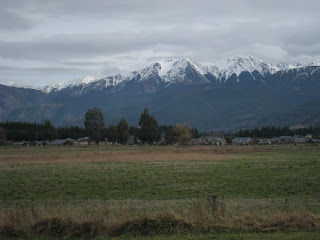
 to Christchurch, where we visited the lovely botanic garden, featuring more gondola-like punting down the Avon River and a beautiful fountain, in addition to all of the trees and flowers.

 We spent our last night in New Zealand in
  The
The  And here are some of the art installations on the grounds:


 My partner liked the black swan best:
 These peacocks were wandering around the picnic area, and I thought this synchronized pecking was funny:


 The poor wombat was pacing back and forth. I think the peacock eyeing him made him nervous.
 My favorite, though, was the koala:
 I'm not a stuffed animal person or one of those cooing 'how cute' types usually, but man, these koalas are irresistable. No teddy bear could ever match how cute they are, and they are the perfect size for snuggling.
 They just sleep and look peaceful while curled into a little ball, or they stuff eucalyptus leaves in their face when they're awake.
 We awoke to a beautiful sunrise in Newcastle the next morning...
 and discovered that the Aussies are a lot smarter when it comes to train seat design, as these seat backs could be swiveled to face either direction, allowing passengers to face forward no matter which way the train is going.
 Continuing on, we took the Intercity train back to
  The beaches reminded me of perfect
 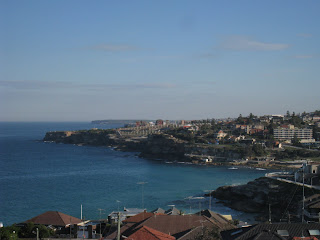 Bondi had some neat graffiti art and some great mosaic walls:
 We enjoyed a nice sunset on our last night:


 When the sun went down, surfers started coming in:
 We got to meet up with a couple from our diving course in the
  We hung out at a swanky German bar after that, rounding out a perfect last day in Australia, and then said goodnight to Bondi (and goodbye to Australia) before catching an early flight back to L.A.
 Dunedin is known as New Zealand's Scottish town, and its buildings remind me of large gingerbread houses.


 We saw remnants of an old stone bridge right next to the (newer) one we drove across:
 We saw more rolling hills of sheep...
 the perfect screensaver through the bus windshield...
 and giant fruits and vegetables:
 In Dunedin, we stayed with the sweetest couchsurfer, Timo, an anthropology professor who studies death and evil. Needless to say, conversation was endless and fascinating.
 We had a lovely room with windows on all sides (and a funky zebra print bed):
 Not to mention our sunset view:
 (One would be hard-pressed to guess, when seeing Timo feeding ice cream to random cats on the street and playing with his neighbor's dog, that he studies death and evil. Of course, maybe he just couldn't stand being such a sweet and gentle guy, he had to go and study something macho. Heh heh. Kidding, Timo.)
 When we walked by this intersection a little later, we saw two guys climbing out of the window and onto the balcony. If you look closely in front of the green building, you'll see a guy sitting on a couch playing a guitar.
 One unique feature about Dunedin that I thought was neat: the center of town is an
  As we walked around, we found the train station (which resembled a fancy gingerbread house):


 Considering it was winter, the delicate poppy-like flowers in front of the station were amazing:
 The University of Otago was another fancy gingerbread building, and there was art everywhere. If you look in the canal in front of the university, you'll see three paintings just hanging there.
 This sculpture in front of the university sign is of a gorilla (made of old car parts, I think) dominating an old car:
 Even the Dunedin prison was beautiful:
 We went to the Otago Settlers Museum, which was free and had neat exhibits on Maori history and culture and the evolution of transportation in New Zealand.

 I was surprised to discover a terrific exhibit about Chinese settlers in New Zealand. A lot of them came for the Gold Rush (right after California's), and while it was mostly men at first who came to work, send money home, and then move back to China, eventually, families began settling here, too.
 We also went to the Chinese garden, which was beautiful and tranquil. Like the Peabody Essex in Salem's


 I still got a kick out of the more formal English, and seeing signs like "Trundler Park" made me smile. (They're referring to the grocery carts.)
 It seems like Kiwis don't like to cook, as there are take-out places everywhere. While many of them are Asian of some kind (Chinese, Thai, Korean, Cambodian, Indian...), lots of them are like this one, with Chinese food, fish 'n' chips and burgers all in one place (with a convenience store to boot):
 One night, Timo drove us to the top of a nearby mountain, where we had an incredible view of Dunedin and the water. It was really cool to see the sun set and the city lights come up.


