01 April 2011

why do people confuse muslims and terrorists?

NY Times
I just don't understand how this Pastor Terry Jones can condemn an entire religion.  I wonder if he has traveled to a Muslim country, how many Muslims he knows well-- if any.  And how can a religious man burn a holy text and not feel remorse?  It breaks my heart and really embarrasses me.

NY Times
It isn't any wonder, then, that there is so much anti-American sentiment.  The sad part is that all these angry Muslims that attacked the UN in Afghanistan and killed four Nepalese and three Europeans (a Romanian, a Swede and a Norwegian) are taking out their frustration with this one pastor and applying it to all Americans.  But because Mazar-i-Sharif is considered "among the safest cities in Afghanistan," and there were no Americans readily available to attack, these poor UN workers from Asia and Europe took the brunt of their anger.

It seems so obvious to me that there are plenty of nice, intelligent Muslims, as well as plenty of nice, intelligent Americans-- if we could just take the 0.0001% of crazy fanatics that do these shockingly offensive things and show them the humanity of the "other," it seems we could probably all get along pretty well.

Can't we all just practice peace, love and understanding?  I'm pretty sure it's what most people want.

30 March 2011

goodbye, harvard law school. hello, dreams.

Tucuman, Argentina
Not many would have the chutzpah to turn down a Harvard Law School acceptance, but if you know in your heart that you have another stronger passion within you, it does seem to be the only right thing to do.  

One of my favorite quotes is from Paulo Coelho's 
The Alchemist:
"It is the possibility of having a dream come true  
that makes life interesting."
So, cheers to Matt Clair, who is following his heart and going after his dream of becoming a writer.  He's starting a blog called 365, in which he'll write a 365-word story every day for a year.  

Like a proud parent (or older sister), I look at my old Dunster students and feel so lucky to have spent time with such incredible people.  Thanks for sharing your lives with me.


And in case you need a little inspiration to pursue
your dream, here's an old piece by Nicholas Kristof.  (Thanks, Yeimy, for the reminder!)

Triumph of a Dreamer


Published: November 14, 2009

Any time anyone tells you that a dream is impossible, any time you’re discouraged by impossible challenges, just mutter this mantra:Tererai Trent.

Of all the people earning university degrees this year, perhaps the most remarkable story belongs to Tererai (pronounced TEH-reh-rye), a middle-aged woman who is one of my heroes. She is celebrating a personal triumph, but she’s also a monument to the aid organizations and individuals who helped her. When you hear that foreign-aid groups just squander money or build dependency, remember that by all odds Tererai should be an illiterate, battered cattle-herd in Zimbabwe and instead — ah, but I’m getting ahead of my story.

Tererai was born in a village in rural Zimbabwe, probably sometime in 1965, and attended elementary school for less than one year. Her father married her off when she was about 11 to a man who beat her regularly. She seemed destined to be one more squandered African asset.


A dozen years passed. Jo Luck, the head of an aid group called Heifer International, passed through the village and told the women there that they should stand up, nurture dreams, change their lives.

Inspired, Tererai scribbled down four absurd goals based on accomplishments she had vaguely heard of among famous Africans. She wrote that she wanted to study abroad, and to earn a B.A., a master’s and a doctorate.

Tererai began to work for Heifer and several Christian organizations as a community organizer. She used the income to take correspondence courses, while saving every penny she could.

In 1998 she was accepted to Oklahoma State University, but she insisted on taking all five of her children with her rather than leave them with her husband. “I couldn’t abandon my kids,” she recalled. “I knew that they might end up getting married off.”

Tererai’s husband eventually agreed that she could take the children to America — as long as he went too. Heifer helped with the plane tickets, Tererai’s mother sold a cow, and neighbors sold goats to help raise money. With $4,000 in cash wrapped in a stocking and tied around her waist, Tererai set off for Oklahoma.

An impossible dream had come true, but it soon looked like a nightmare. Tererai and her family had little money and lived in a ramshackle trailer, shivering and hungry. Her husband refused to do any housework — he was a man! — and coped by beating her.

“There was very little food,” she said. “The kids would come home from school, and they would be hungry.” Tererai found herself eating from trash cans, and she thought about quitting — but felt that doing so would let down other African women.

“I knew that I was getting an opportunity that other women were dying to get,” she recalled. So she struggled on, holding several jobs, taking every class she could, washing and scrubbing, enduring beatings, barely sleeping.

At one point the university tried to expel Tererai for falling behind on tuition payments. A university official, Ron Beer, intervened on her behalf and rallied the faculty and community behind her with donations and support.

“I saw that she had enormous talent,” Dr. Beer said. His church helped with food, Habitat for Humanity provided housing, and a friend at Wal-Mart carefully put expired fruits and vegetables in boxes beside the Dumpster and tipped her off.

Soon afterward, Tererai had her husband deported back to Zimbabwe for beating her, and she earned her B.A. — and started on her M.A. Then her husband returned, now frail and sick with a disease that turned out to be AIDS. Tererai tested negative for H.I.V., and then — feeling sorry for her husband — she took in her former tormentor and nursed him as he grew sicker and eventually died.

Through all this blur of pressures, Tererai excelled at school, pursuing a Ph.D at Western Michigan University and writing a dissertation on AIDS prevention in Africa even as she began working for Heifer as a program evaluator. On top of all that, she was remarried, to Mark Trent, a plant pathologist she had met at Oklahoma State.

Tererai is a reminder of the adage that talent is universal, while opportunity is not. There are still 75 million children who are not attending primary school around the world. We could educate them all for far less than the cost of the proposed military “surge” in Afghanistan.

Each time Tererai accomplished one of those goals that she had written long ago, she checked it off on that old, worn paper. Last month, she ticked off the very last goal, after successfully defending her dissertation. She’ll receive her Ph.D next month, and so a one-time impoverished cattle-herd from Zimbabwe with less than a year of elementary school education will don academic robes and become Dr. Tererai Trent.


29 March 2011

a boeing tree house


via

So, I saw this on the good news network and thought it was awesome.  This lady in Mississippi spent $2000 on an old airplane, paid $4000 to move it to her land, fixed it up for $24,000, and now has this awesome airplane house.

However!  A little research shows this photo is actually of a hotel room in Manuel Antonio, Costa Rica.   A pretty awesome one for either $250/night or $500/night, depending on what time of year you go.

via
via

28 March 2011

happy feist and some badly drawn boy

After a rainy spring break, we finally have beautiful weather again (just in time for the first day of the new quarter).  Here's a little happy Feist Mushaboom to celebrate.


And I love the ending of this video (from "About a Boy").  Reminds me a bit of Wall-E.  Enjoy!


Have a beautiful day. 

13 March 2011

gabriel dawe

www.gabrieldawe.com
Poor Japan.  I teared up when I saw some video clips of the earthquake/tsunami damage on the New York Times website.

So, I offer you a happy, colorful respite.  Mexican-born, Texas-based artist Gabriel Dawe uses over fifty miles of brightly colored thread to create these amazing installations that feel so light and yet have such potent color.

The Fast Company introduction:
Dawe was born in Mexico and says a lot of his work is about challenging the machismo culture of his homeland...  Ergo, his attraction to thread-- which in Mexico is associated almost exclusively with sewing (i.e. women's work). 

www.gabrieldawe.com
You can see some slide shows here or check out his website for more info.  Enjoy!

22 February 2011

from egypt to wisconsin

Good News Network

Pizza.  It's a simple way to show solidarity, but pizza donations to support the protesters in Wisconsin have been pouring in from all over the world.  Politico says these giving countries include Korea, Finland, New Zealand, Egypt, Denmark, Australia, the US, Canada, Germany, China, England, the Netherlands, Turkey, Switzerland and Italy.

It always amazes me how very interconnected we all are.  "One World, One Pain" is a pretty apt motto to put on your poster.  Let's hope all the pain is worth it and that we can slowly move forward together.


10 February 2011

crossing into bolivia


Crossing into Bolivia by land is a memorable experience, even if nothing amiss befalls you. For example, maybe you took a bus from Tucumán to the northernmost point of Argentina and then walked to the river crossing, where vendors advertised their boats with sweet hand-painted stalls.


It seemed you just had to pick your favorite boat painting, and you would end up in Bolivia.


So, you examine the boats (and see what other people are getting), buy your ticket and then follow the people in front of you through some tree-covered paths into an opening, from which you discover a river that looks almost wade-able.


But, for just a few cents, you can keep yourself and your belongings dry.


So, you board one of these small boats and figure even if it doesn't quite make it all the way to the other side, the river doesn't look too dangerous.

You sit on a U-shaped bench with mostly female travelers, and without incident, you cross the Argentina-Bolivian border.  


The Welcome to Bolivia sign says Su ingreso es gratuito (your entrance is free), but that isn't entirely true.  You take a look back at the Argentinian side and then head into Bolivia, where, unlike most other countries, there are no immigration officers greeting you. 


Instead, you have been told you have to find someone to stamp your passport because if you are caught without the proper stamp, you will be forced to pay a hefty fine (about US$100, which goes a long way in Bolivia).

So, you ask around (in your excellent Spanish) until you finally find a taxi who will take you the nearest town, and he takes you to the bus terminal.


You are pointed to a small office, but it's still pretty early in the morning, and you are told they open at 8am.  So, you sit and wait, watching the occasional passerby, until the office finally opens.  After a while (and US$135 less for your Bolivian visa), you walk out with your passport stamped, hoping officials will ask to inspect your passport.  Often.


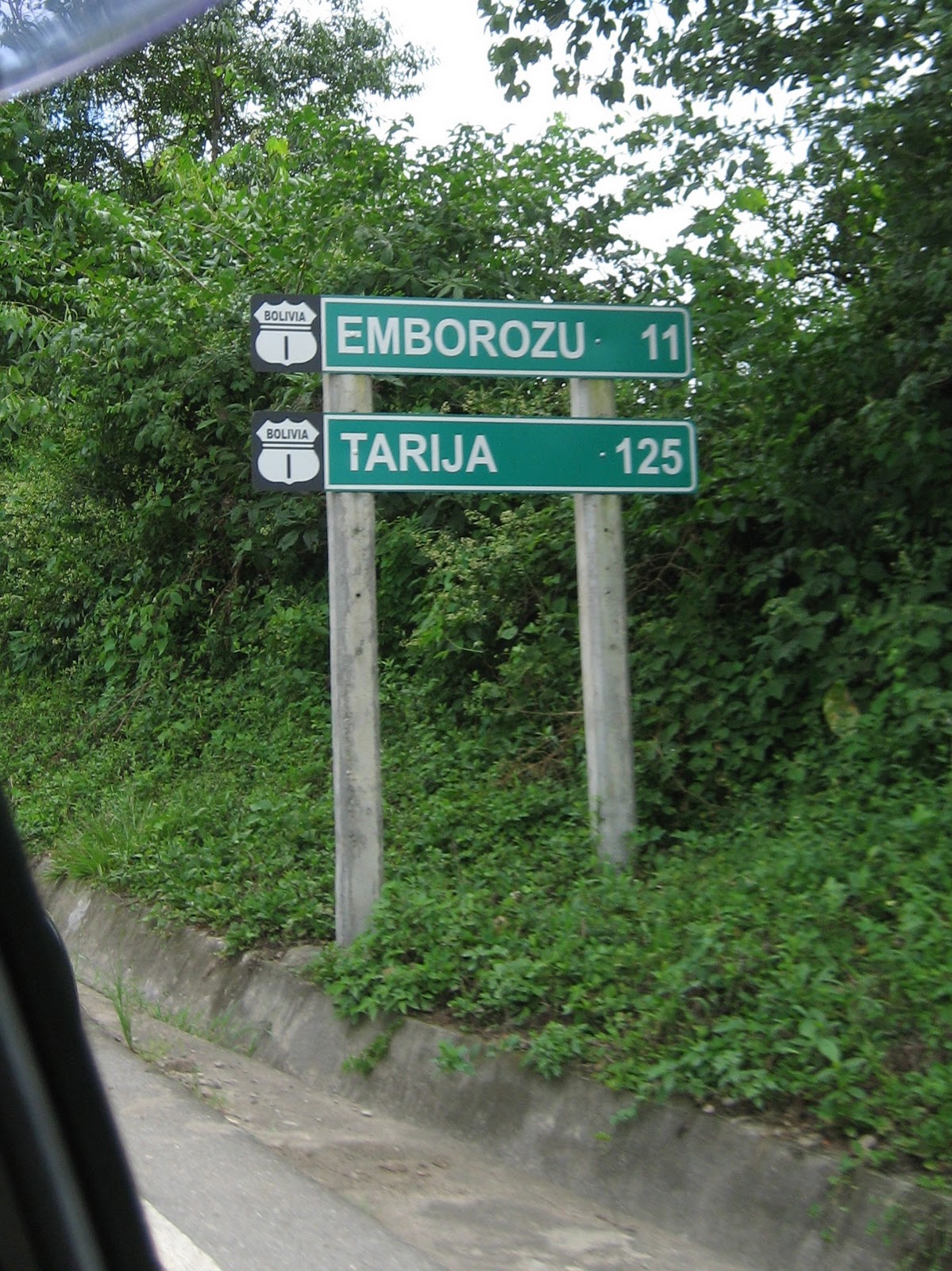
You hop into another taxi and tell him you'd like to go to Tarija.  You notice his modified car seat and think it would be great in the summer for air flow.


You like that you get a scenic tour of the area, and you find it more colorful and lush than you expected.


You hit a little rock avalanche, but are able to get by without too much delay.


You continue on, until your driver goes to a creek to fill his water bottle.  This tells you the water in Bolivia is really clean (or else he has a strong digestive/immune system).


You may not get your camera ready in time, but you pass some beautiful horses:


And lots of rocks with EVO on them in blue.  


You've heard a little about President Evo Morales, and the reviews sound pretty mixed.  Apparently, he is loved for being indigenous and passionate, but it is unclear whether he is really pushing the country in a positive direction.  You decide to enjoy the scenery instead of trying to figure out yet another complicated political drama.


You pass through another small town and marvel at how similar it looks to so many other small towns around the world.


The town wishes you feliz viaje (happy travels), and you continue on, past more beautiful scenery, more blue Evo signs and a young family, all in hats.


Finally, you start to approach Tarija and notice the buses and trucks are quite colorful.


And then you're entering a town that feels like it could be almost anywhere in the world.


Except for the statues...


And the local dress, which is 100% Bolivian.  


You'll find some overlap in other Andean countries, but because I saw the full skirts, long braids, bowler hats and colorful cloth shawls/baby wraparounds here first, they will always be Bolivian to me.

Up next, more of Bolivia.

03 February 2011

chinese new year, fruit valentines and pencil chimes

via
One great thing about being Chinese is the opportunity to feel that fresh "new year" feeling twice.  So, in the name of fresh beginnings (again), Happy Chinese New Year!  May the year of the rabbit be a great one for all of us, filled with love, laughter and great productivity.  (I have been traveling and bouncing about for what feels like months, and I am ready to buckle down and get lots of work done.)

In case you're curious about the Chinese Zodiac (or need a refresher), here are the basics:


Rat
Careful, creative, accumulative, lustful, hoarding and doubting
1900, 1912, 1924, 1936, 1948, 1960, 1972, 1984, 1996, 2008, 2020…

Ox
Patient, preserving, receptive, obstinate, methodical, proud and aggressive
1901, 1913, 1925, 1937, 1949, 1961, 1973, 1985, 1997, 2009, 2021…

Tiger
Wise, compassionate, benevolent, short tempered, proud and aggressive
1902, 1914, 1926, 1938, 1950, 1962, 1974, 1986, 1998, 2010, 2022…

Rabbit
Gentle, friendly, intelligent, discordant, fickle and furtive
1903, 1915, 1927, 1939, 1951, 1963, 1975, 1987, 1999, 2011, 2023…

Dragon
independent, strong-willed, aggressive, powerful, arrogant and prejudice
1904, 1916, 1928, 1940, 1952, 1964, 1976, 1988, 2000, 2012, 2024…

Snake
Idealistic, Intuitive, insightful, financially secure, vain, jealous and egotistical
1905, 1917, 1929 1941, 1953, 1965, 1977, 1989, 2001, 2013, 2025…

Horse
hard-working, sociable, determined, keen sighted, high sensual, talkative, easy to anger
1906, 1918, 1930, 1942, 1954, 1966, 1978, 1990, 2002, 2014, 2026…

Sheep
warm-hearted, graceful, obedient, independent, creative, faithful, pessimistic and sensitive, timid
1907, 1919, 1931, 1943, 1955, 1967, 1979, 1991, 2003, 2015, 2027…

Monkey
Ingenious, resourceful, curious, susceptible, impulsive, scatterbrained
1908, 1920, 1932, 1944, 1956, 1968, 1980, 1992, 2004, 2016, 2028…

Rooster
Visionary, versatile, clever, selfish, poor concentration and ostentatious
1909, 1921, 1933, 1945, 1957, 1969, 1981, 1993, 2005, 2017, 2029…

Dog
Honest, loyal, respectful, stubborn, assertive and demanding
1910, 1922, 1934, 1946, 1958, 1970, 1982, 1994, 2006, 2018, 2030…

Pig
Serious, just, good disposition, reckless, impatient and inflexible
1911, 1923, 1935, 1947, 1959, 1971, 1983, 1995, 2007, 2019, 2031…

Symbolic Meanings of Rabbit


Symbolic Meanings of Rabbit -China New Year 2011According to Chinese traditional legend, rabbits are associated with the Alioth in astronomy. They have a nimble, quick-witted and gentle disposition naturally and are the symbol of good luck. In some coastal areas of Shandong Province in old time, wives usually took a rabbit in their arms when their husbands went to sea to fish, believing that this propitious animal would bring them safeness and good luck. And there is an interesting tradition going that a rabbit’s hair would become absolutely snow-white if it can live for 500 years!
And rabbits have been given many characteristics in China, such as longevity, loveliness, vigilance, fertility, timidity and good hearing.
(Chinese zodiac information from here.)

Now, onto our next upcoming holiday: Valentine's Day!  I know this is a day often greeted with groans and rolled eyes, but here is a cheerful treat that isn't covered in pink and red lace or filled with cheap, overpriced chocolate: fruit valentines, and you'd have to be a real grump not to smile at least a little with these:


So, go ahead and download these DIY stickers for free (yay) at Twig & Thistle and give them to everyone who makes you happy.  (Hey, Valentine's Day doesn't have to be only for significant others-- I say let's celebrate love for everyone we appreciate.)

Here are a couple more for you:


And I came across these at Design*Sponge and loved them.  So simple yet so fun and cheerful:


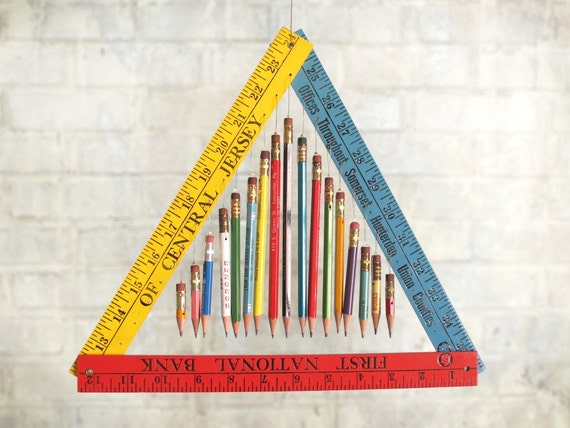
You can go to Vanessa Boer's Etsy shop if you'd like to see more of her work.